Vibroplex Blue Racer Standard (S/N 244472) from 1965
Key Specifications
- Manufacturer: Vibroplex
- Year: 1965
- Type: Bug
- Connection: Two threaded metal studs topped with a knurled nut
History
Acquired via eBay on Dezember 28, 2023.
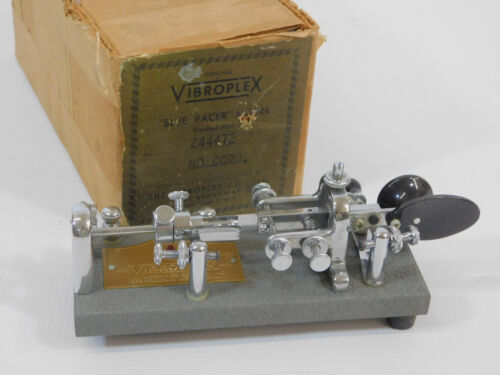
Above: The Vibroplex Blue Racer Standard Vintage 1965 Telegraph Key + Box.
Operating Feel
My Summary: By adding a slightly larger weight and using a Dot Stabilizer according to the article Round Bar Dot Stabilizer by Aubrey J. Sheldon – W0EB (PDF), this isn’t just a race car for the shack, for me it is a compact, high-precision instrument that, with the right transport box, brings the joy of mechanical CW to the great outdoors.
More details: When you look up the Vibroplex Blue Racer on the internet, you quickly run into a wall of warnings. The forums and reviews are unanimous: this key is a “nervous” creature. They say the smaller frame and lighter pendulum make it a speed demon, difficult to tame below 25 WPM, and generally unsuited for anyone but the most dexterous operators. The common consensus is that the Blue Racer is a “Ferrari” compared to the “Cadillac” ride of the Original—twitchy, fast, and demanding.
I acquired this 1965 model knowing all of this - but after spending time with it, my personal reflection on its “operational feel” is quite different from the scare stories.

Above: Close-up of my homebrew weight and de-bouncer for the Blue Racer.
A Different Perspective: The Portable Bug
Where others see a “twitchy” key that belongs on a heavy oak desk, I see the perfect portable bug.
The “Standard” Blue Racer sits on a base that is only 2.5 inches wide—significantly narrower and lighter than the massive Vibroplex Original. In the shack, mass is an asset. But in the field, mass is a penalty.
I have found that this key suits my portable operations perfectly, provided one specific condition is met: Transport Safety. Because the Blue Racer exposes all its delicate mechanical guts — the damper, the pendulum, the contacts — it cannot simply be thrown into a rucksack. However, if transported in a custom-fitted box or a hard-shell case where the pendulum is additionally immobilized, it becomes the ultimate field instrument.
The Feel Subjectively, the key does not feel “nervous” to me; it feels responsive. The 1965 mechanism has settled into a smooth groove. Yes, the dot action is faster than a standard bug, but it encourages a lighter, more disciplined fist. You cannot “slap” a Blue Racer; you have to caress it. When I am sitting at a portable table anywhere outside, that lighter touch actually helps, as it requires less force to stabilize the base.
Intuitive Adjustment Another point often overlooked is the simplicity of the mechanism. There are no hidden magnets or complex tensioners here. The adjustment is self-intuitive and easy.
In the field, I don’t want to fiddle with hex keys or complex spring arrays. The Blue Racer is honest machinery. If the dots are too light, you see the spring that needs tightening. If the travel is too far, you see the screw that stops it. It allows me to dial in the “feel” in seconds, matching my fist to the conditions of the day.
Additional Comments
I recently had the pleasure of contributing an article to the AGCW Kurier 2/24 (PDF). The topic was one that many vintage bug operators struggle with: how to slow these mechanical keys down to a comfortable conversational speed without breaking the bank on shipping heavy weights from overseas. So here is the English translation of my DIY journey into crafting custom weights for my Vibroplex and Lionel keys:
PSE QRS…
…but the small (original) weight on the bug is already pushed “all the way back”—yet I still need to go slower. I need heavier weights. A quick internet search reveals that finding them means either luck (a random eBay listing) and/or paying expensive postage from overseas… or perhaps just a little manual labor? After all, the job title used to be “Radio Mechanic”—so I decided not to let my mechanical skills completely atrophy in the amateur radio world of 2024, and I accepted the challenge.
The Prototype
I moved the current weight to its most extreme rear position and provisionally attached “thick” steel nuts using some modeling putty until I reached my target speeds. Then, I took everything off, weighed the assembly, and noted the data.
The Materials
I found round and square brass rods (available in lengths from 10cm) at various online dealers for immediate delivery and at fair prices. Weighing the full rods and calculating the ratio against my target weights (minus the weight of the screw) gave me the exact cutting lengths required.
The Build
I am not blessed with a fully equipped machine shop, but all you really need is a hand saw, a file, a drill, a thread cutter (tap), and some sandpaper. The use of a hand saw was the main reason I chose brass rather than steel.
- For the Vibroplex Bugs (with the round pendulum): I sawed off discs, drilled a 4.5mm hole in the center, and drilled a 3.3mm hole from the edge until the two met. I then cut an M4 thread into the side hole to accept the knurled locking screw.
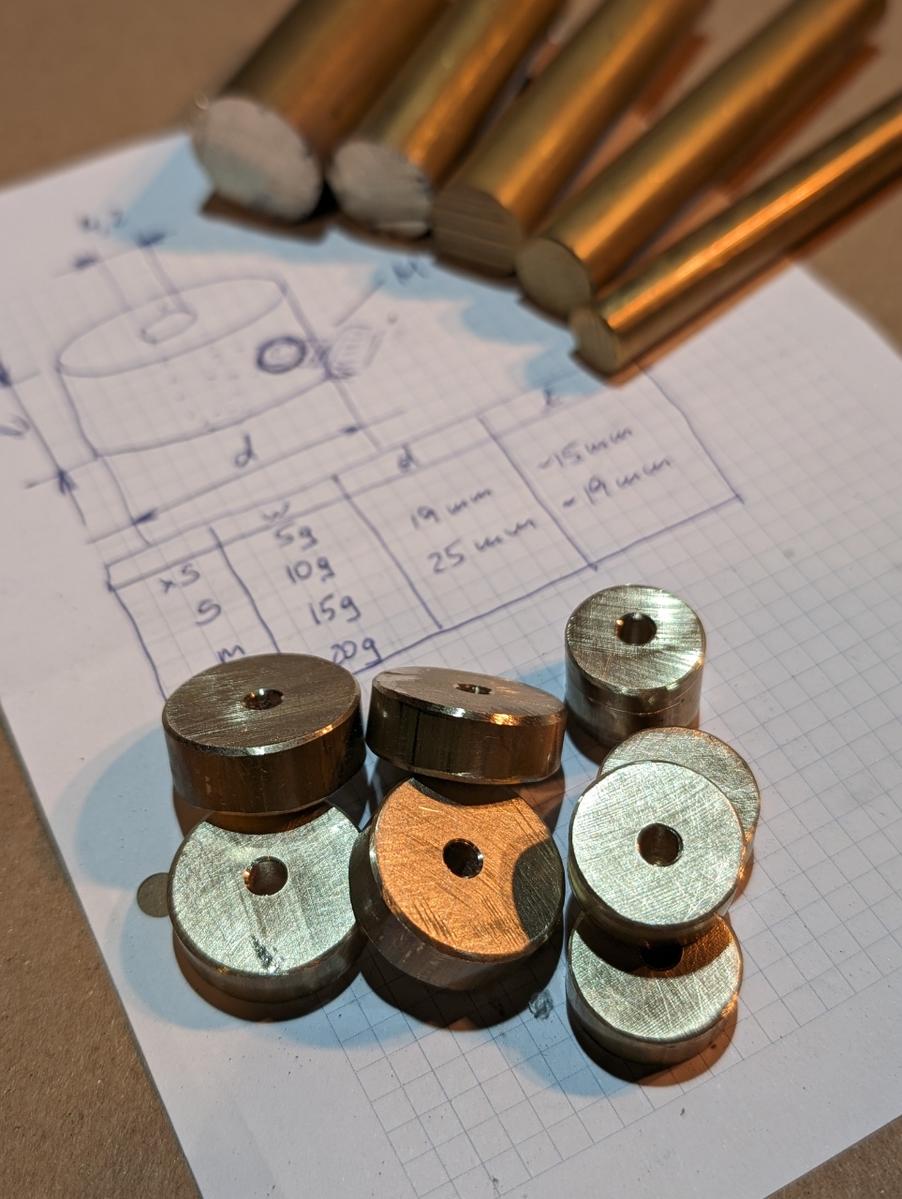
The Weighting Game: Inside the Factory
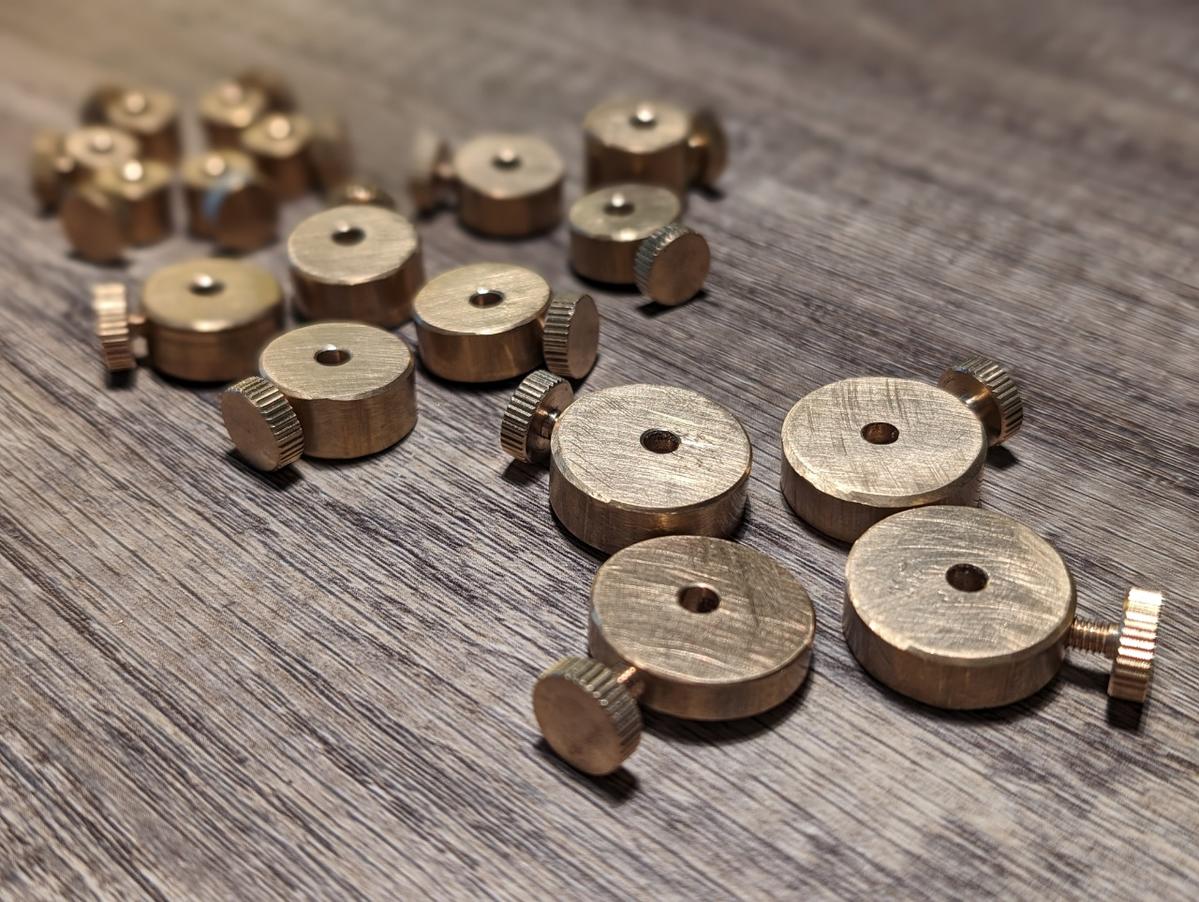
The ready Product: My round Weights.
- For the Lionel J-36: I sawed rectangular blocks, drilled a 3.3mm hole for the M4 thread, and sawed a small slot. I then widened the slot with a file until the block fit perfectly over the flat pendulum bar. A little polishing, and it was done.
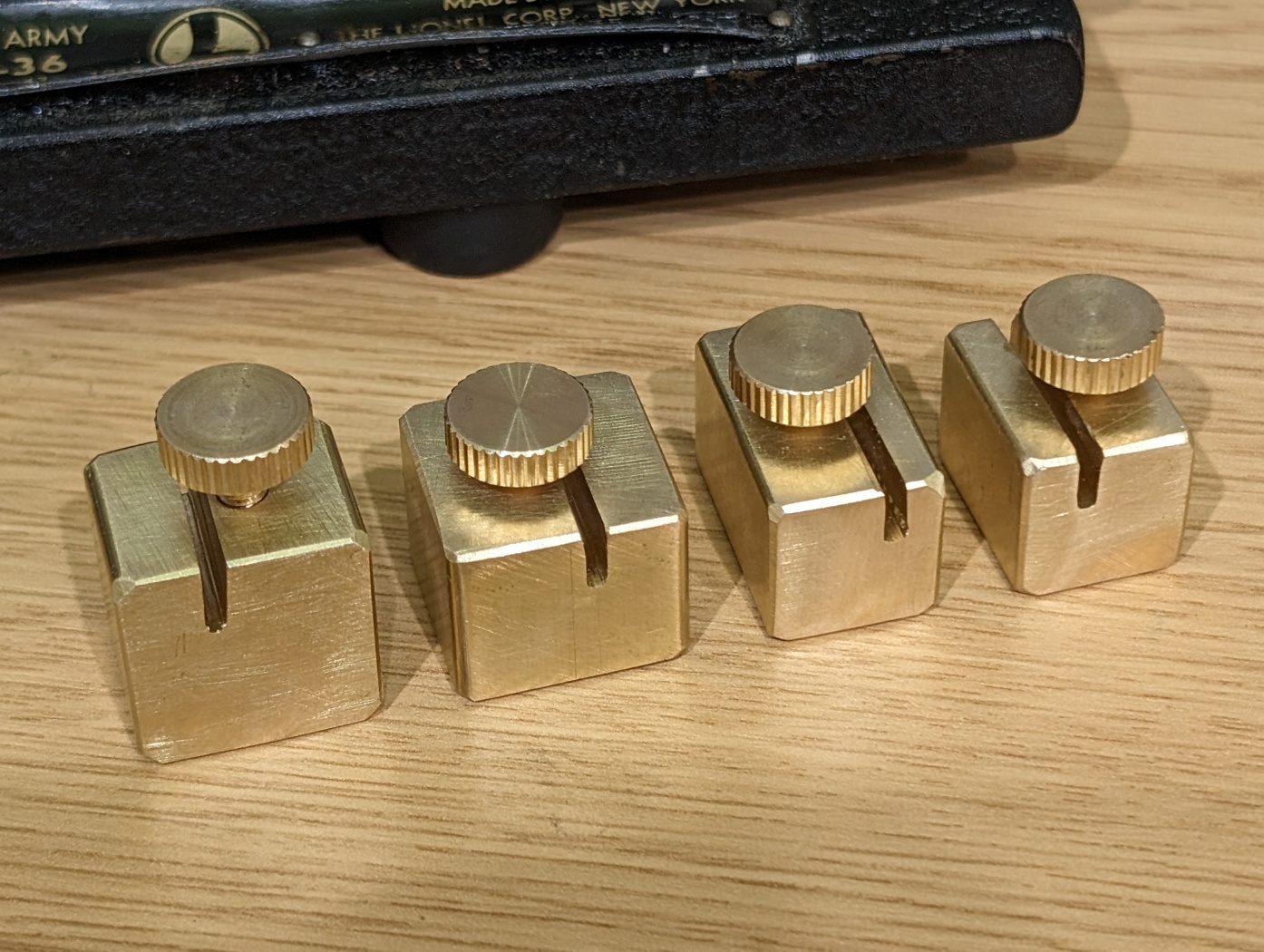
The J-36 Weights Set.
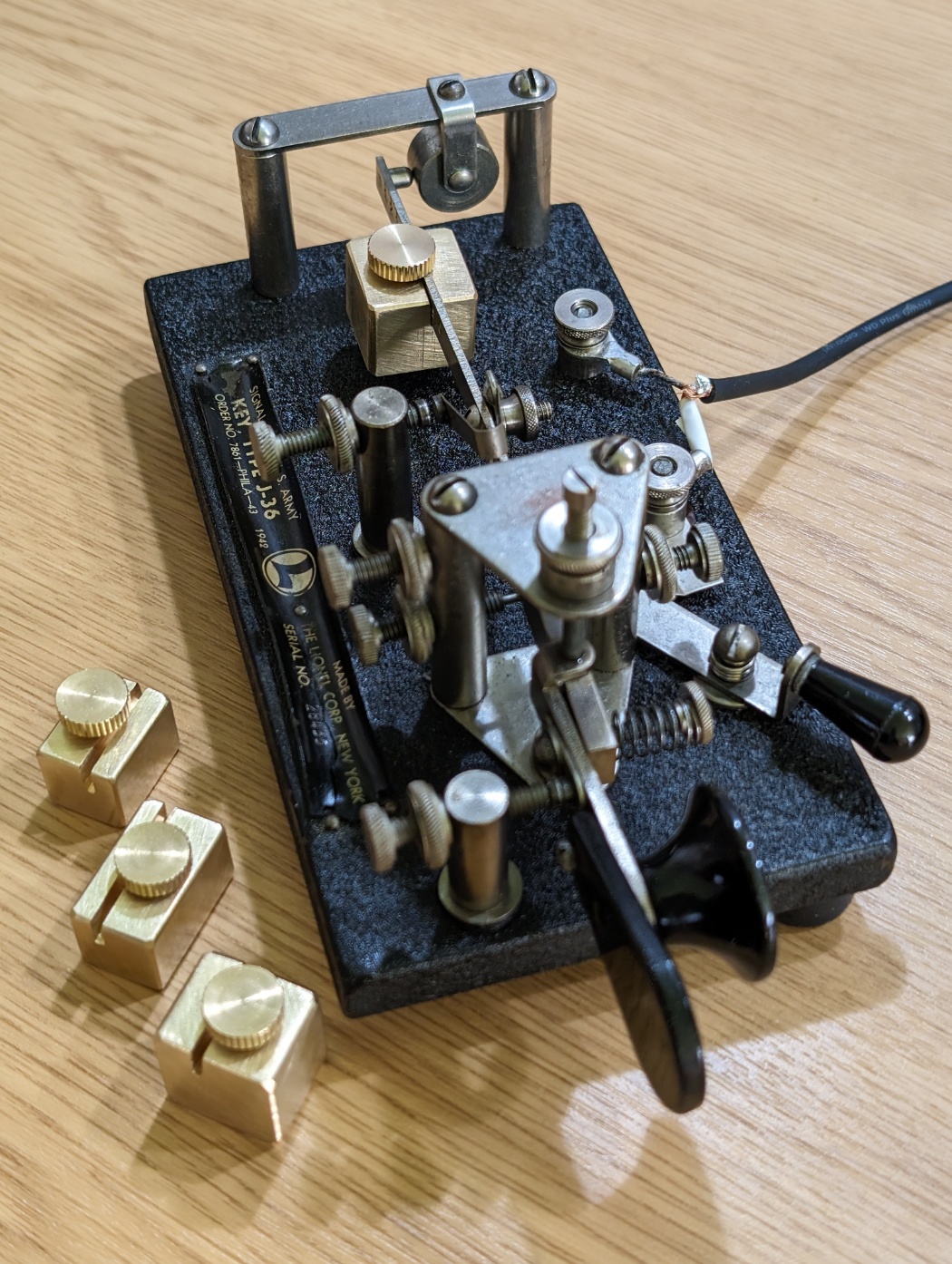
The J-36 and its new Weights.
The Result
I cannot (yet) judge whether my weights—which go up to 60g—might cause the bearings to wear out faster (although Benny, K5KV, once told me: “You will not hurt a bug with extra weight no matter what you read on the Internet”).
However, in contrast to the longer, thinner original weights, my shorter but significantly thicker/heavier weights offer a much greater speed variance—ranging from 36wpm down to 14wpm. (For anything slower than that, I reach for the Junker MT anyway).
So, for the future: PSE QRS… O K N W Q R S