The 1942 Lionel J-36 (S/N 28435): A Masterpiece of Wartime Precision
Key Specifications
- Manufacturer: Lionel
- Year: 1942
- Type: Bug
- Connection: Two threaded metal studs topped with a knurled nut
History
Scored via eBay on March 29, 2024.
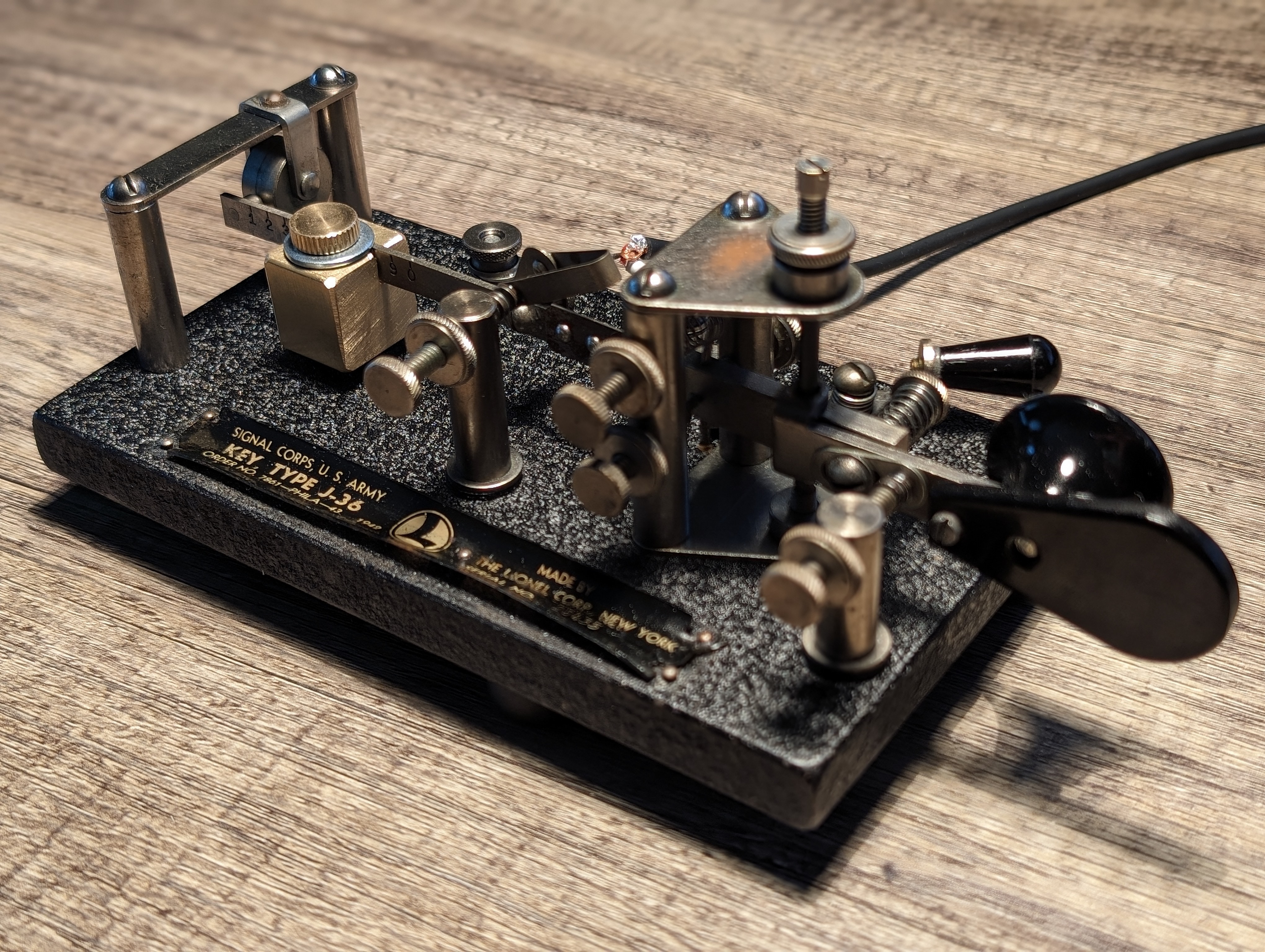
Above: My favorite bug - the Lionel J-36 from 1942.
Operating Feel
Operating this 1942 Lionel J-36 is a remarkably fluid experience, offering a tactile smoothness that speaks to its high-quality vintage construction. While it bears the standard U.S. Army Signal Corps “J-36” designation — a label applied to all semi-automatic bugs during WWII — this specific unit is something special. Manufactured by the Lionel Corporation, the same company famous for their electric toy trains, it carries an industrial elegance that sets it apart from the standard Vibroplex models of the era.
The Operating Feel: Fluidity and Authority The heavy base is a standout feature, anchoring the unit so securely that it eliminates any unwanted sliding, even during rapid keying. Unlike lighter keys that end up “walking” across the desk during a heated pileup, the Lionel sits dead still. This stability pairs perfectly with the generous length of the arm, which provides excellent leverage and spatial freedom.
The geometry allows for a comfortable, natural roll of the wrist, making every dot and dash feel effortless and precise. Because Lionel modeled this key directly after the Vibroplex “Lightning Bug” (Model 6) rather than the “Original,” it utilizes a flat pendulum bar and a slightly different leverage point. The result is a key that feels less “whippy” and more deliberate. The mainspring tension is authoritative — often cited as being slightly stiffer than civilian bugs — which gives the return action a crisp, military snap. It doesn’t just swing; it drives. :-)
Mechanical & Historical Distinctions To the uninitiated, it looks like just another bug, but the details tell the story of its 1942 origin.
The “Rounded” Paddle: One of the subtle tactile joys is the dot paddle. Unlike the squared-off paddles found on many other J-36 variants, the Lionel features a distinctive rounded thumb piece that feels incredibly natural against the digit during long operating sessions.
Precision Manufacturing: When Lionel halted train production to support the war effort, they brought their mastery of mass-production stamping and machining to this key. There are no rough casting marks here; the parts are stamped and machined with a consistency that often exceeded the quality of the actual Vibroplex units of the same year.
The Fragile Identity: This unit likely bore the famous — and notorious — long celluloid label on the top of the base. These plastic tags were prone to shrinking and popping off over the last 80 years, making my unit with its identity almost intact a rare survivor. ;-)
Why It remains the Favorite It is a paradox of a key: built for the harsh utility of the Signal Corps, yet possessing a “Cadillac” smoothness that rivals modern instruments. Whether I am slowing it down for a ragchew or letting the pendulum fly at 35wpm, the Lionel J-36 doesn’t just send code; it connects me directly to the golden age of telegraphy. It is, quite simply, the best seat in the house.
Additional Comments
I recently had the pleasure of contributing an article to the AGCW Kurier 2/24 (PDF). The topic was one that many vintage bug operators struggle with: how to slow these mechanical keys down to a comfortable conversational speed without breaking the bank on shipping heavy weights from overseas. So here is the English translation of my DIY journey into crafting custom weights for my Vibroplex and Lionel keys:
PSE QRS…
…but the small (original) weight on the bug is already pushed “all the way back”—yet I still need to go slower. I need heavier weights. A quick internet search reveals that finding them means either luck (a random eBay listing) and/or paying expensive postage from overseas… or perhaps just a little manual labor? After all, the job title used to be “Radio Mechanic”—so I decided not to let my mechanical skills completely atrophy in the amateur radio world of 2024, and I accepted the challenge.
The Prototype
I moved the current weight to its most extreme rear position and provisionally attached “thick” steel nuts using some modeling putty until I reached my target speeds. Then, I took everything off, weighed the assembly, and noted the data.
The Materials
I found round and square brass rods (available in lengths from 10cm) at various online dealers for immediate delivery and at fair prices. Weighing the full rods and calculating the ratio against my target weights (minus the weight of the screw) gave me the exact cutting lengths required.
The Build
I am not blessed with a fully equipped machine shop, but all you really need is a hand saw, a file, a drill, a thread cutter (tap), and some sandpaper. The use of a hand saw was the main reason I chose brass rather than steel.
- For the Vibroplex Bugs (with the round pendulum): I sawed off discs, drilled a 4.5mm hole in the center, and drilled a 3.3mm hole from the edge until the two met. I then cut an M4 thread into the side hole to accept the knurled locking screw.
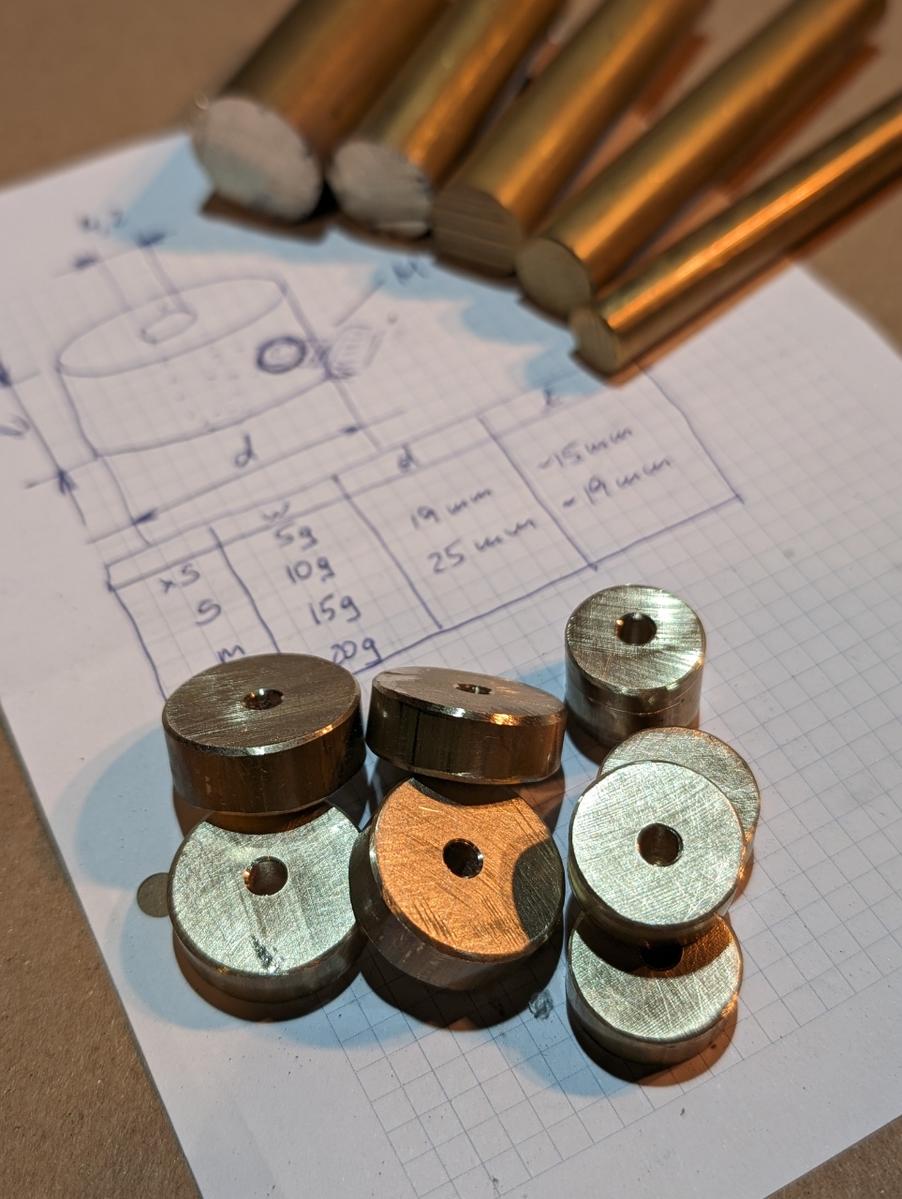
The round weights.
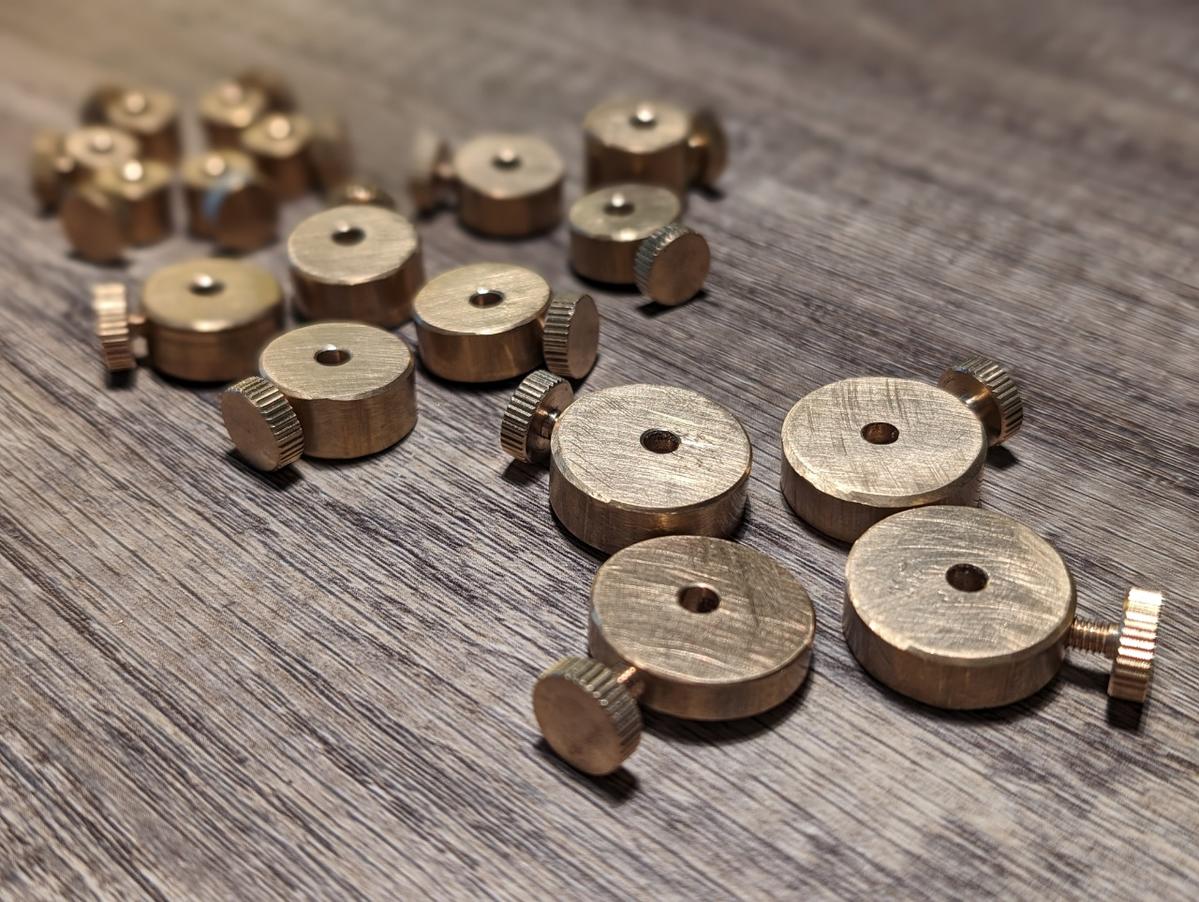
The round weights.
- For the Lionel J-36: I sawed rectangular blocks, drilled a 3.3mm hole for the M4 thread, and sawed a small slot. I then widened the slot with a file until the block fit perfectly over the flat pendulum bar. A little polishing, and it was done.
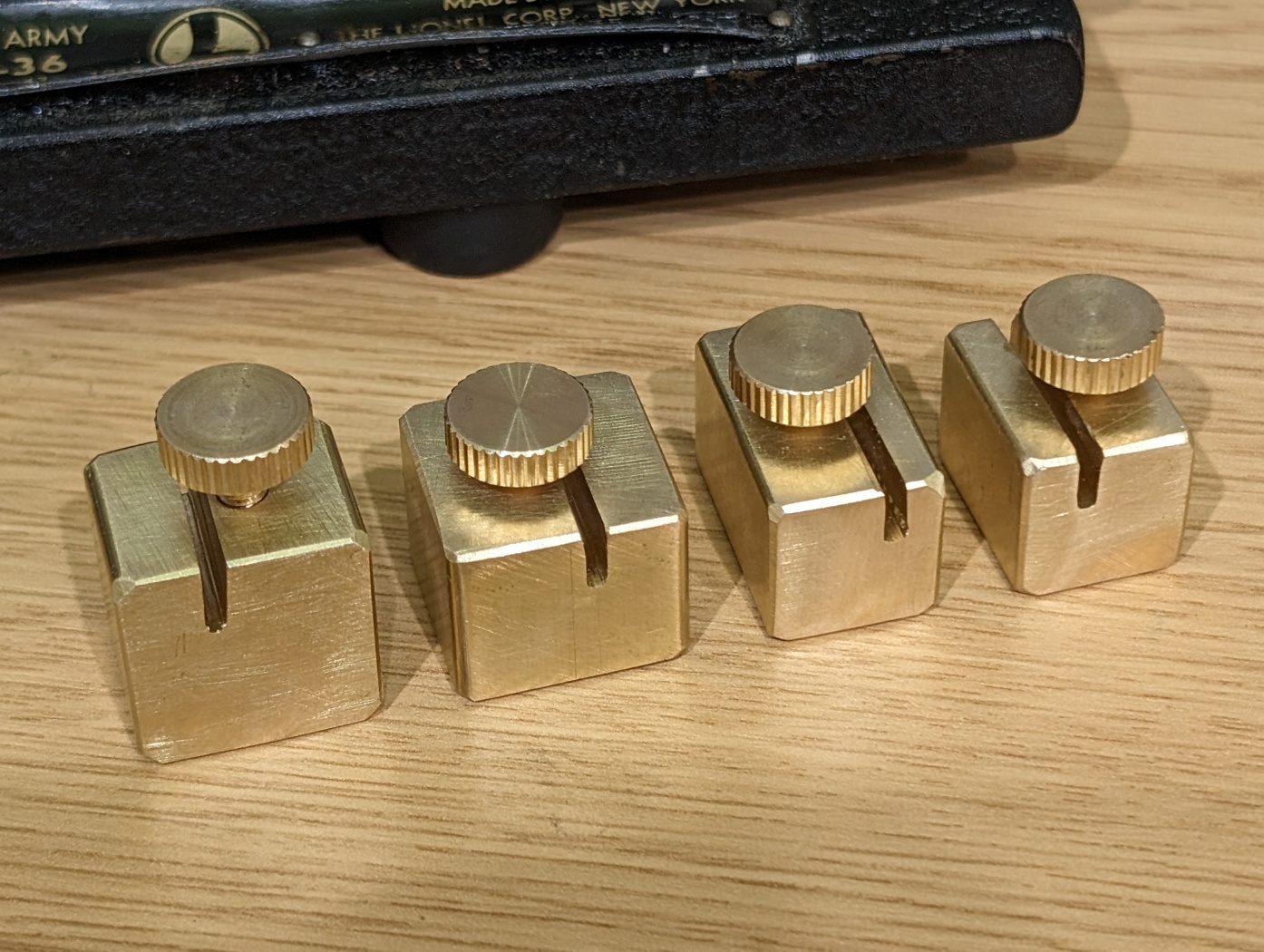
The J-36 weights.
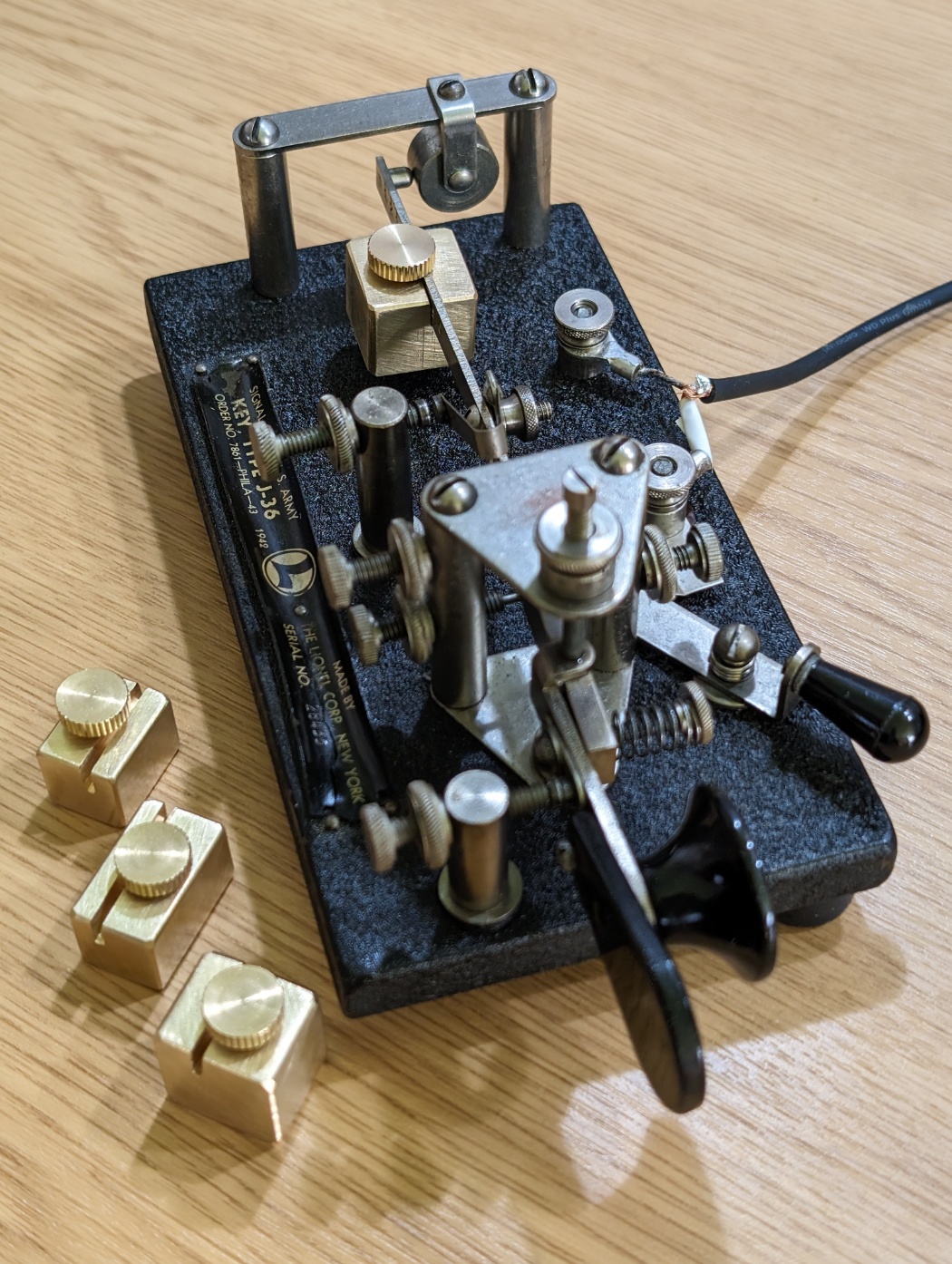
The J-36 weights.
The Result
I cannot (yet) judge whether my weights—which go up to 60g—might cause the bearings to wear out faster (although Benny, K5KV, once told me: “You will not hurt a bug with extra weight no matter what you read on the Internet”).
However, in contrast to the longer, thinner original weights, my shorter but significantly thicker/heavier weights offer a much greater speed variance—ranging from 36wpm down to 14wpm. (For anything slower than that, I reach for the Junker MT anyway).
So, for the future: PSE QRS… O K N W Q R S