HI MOUND BK 100
Key Specifications
- Manufacturer: HI MOUND
- Type: Bug
- Connection: Two Internal Screw Terminals
History
It found its way to my station via eBay on September 3, 2024.
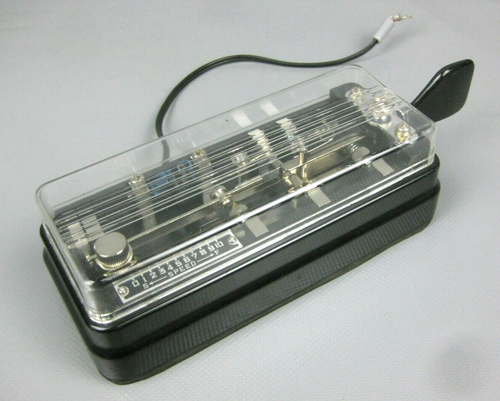
Above: The HI MOUND BK 100.
Operating Feel
In short: It is not a key for the “glass arm” operator who wants a feather-light touch. It is a key for the operator who wants to feel the mechanism click, who likes a consistent, high-tension return, and who wants a bug they can toss in a go-bag without fear. Just don’t expect to change your speed in the middle of a QSO!
A bit more detailed: For the CW operator who has never laid hands on a Hi-Mound BK-100, the experience is distinct — a mix of Japanese mechanical precision and a very specific, polarizing user interface. Often affectionately (or notoriously) called the “Coffin Bug” due to its rectangular, boxy shape, this key is a fascinating piece of gear. If you are coming from the world of Vibroplexes, the BK-100 will feel like a completely different animal.
1. The Tactile Experience: “Snap” over “Swing”
The most immediate sensation when using a BK-100 is its stiffness.
The Hard Spring Tension: unlike the “soft” or “mushy” feel of some well-worn American bugs that seem to swing effortlessly, the BK-100 is known for a tighter, harder spring tension. The main lever returns to center with authority. You don’t “caress” a BK-100; you actuate it.
The Result: This high tension makes the key feel very responsive and “fast.” It resets instantly. However, for an operator used to a lighter touch, it can feel like a workout. ;-) You need a deliberate fist. If you have a “lazy” thumb, this key will expose it immediately.
The “Dah” Side: Since the dash side is purely manual, that hard spring tension means you have complete control, but you have to earn every dash. It feels solid, mechanical, and unforgiving.
The “Dit” Side: The pendulum mechanism is snappy. Because of the tension, the dots fire like a machine gun. They are crisp and articulate, but they lack that “rolling” feel of a slower bug.
2. The Spacing: Precision Required
The small spacing is a critical characteristic of the BK-100.
Short Travel: The gap between the contacts is typically kept very narrow on these keys to accommodate the stiff springs. If the gap were wide and the spring stiff, it would be exhausting to use.
The Consequence: This short throw means your timing must be impeccable. There is very little “travel time” to correct a mistake. If your spacing floats, the key won’t hide it. It produces a very staccato, piercing style of CW that cuts through QRM well but sounds “choppy” if your rhythm isn’t perfect - and thats exactly where my personal challenge with this bug is…
3. The “Coffin” Housing: A Portable Paradox
The defining feature of the BK-100 is its clear (or sometimes smoked) plastic cover that encloses the entire mechanism. This case is the source of both its greatest utility and its biggest frustration.
The Good (Portable Operations): For a portable operator, the housing is brilliant when it comes to protection during transports.
Dust & Debris Proof: Unlike an exposed Vibroplex, you can throw the BK-100 into a backpack, and you don’t have to worry about lint getting between the contacts or the pendulum getting bent by a stray cable.
Stability: It usually sits on a heavy base with a low center of gravity, making it sit still on a picnic table or a rock.
The Bad (The “QRS” Nightmare): Here is the scenario that drives me crazy:
I’m in a QSO, lets say at 23 WPM. The band conditions change, or I connect with an operator sending at 16 WPM. I naturally want to slow down to match their speed.
On a standard bug, I would just reach out with my left hand, slide the weight down the pendulum, and keep sending. On the BK-100, I cannot do this. The speed weights are locked away inside the “coffin”. To change speed, I have to:
- Stop sending.
- Unclip the plastic cover.
- Adjust the weight.
- Put the cover back on (or leave it off and risk bumping it).
This makes the BK-100 a “set it and forget it” key - find a “sweet spot” speed and leave it there forever. Mine is still at 23wpm.