Swinging the Sideswiper (Cootie)
CW Adventure - My Journey with the Sideswiper ✨
This page documents my effort to master one of the most unique and historically significant Morse keys: the Sideswiper, often affectionately called the “Cootie.” Although I had such key been sitting on my shelf for many years, the urge to actually use it struck me out of the blue at the end of January ‘26. I decided it was finally time to dust it off and learn the art of the Cootie.
What is a Sideswiper?
The Sideswiper (also known as a Maniflex or Double-Speed Key) sits somewhere between a traditional straight key and a modern paddle.
- The Mechanism: Unlike a straight key (up/down) or a bug (semi-automatic), the Cootie uses a horizontal lever that makes contact on both the left and right sides.
- No Electronics: Unlike a paddle connected to an electronic keyer, the Cootie is purely manual. There are no springs or chips to make the dots and dashes for you. You control the duration of every signal manually.
The “Cootie” Sound 🎧
Why use one? Aside from looking cool, it was originally invented to prevent “Glass Arm” (an early term for RSI). Today, operators love it for the signature sound. A skilled Cootie operator has a distinct, “singing” rhythm that adds personality to the signal, which is often described as having a pleasant “swing.”
How to Operate It
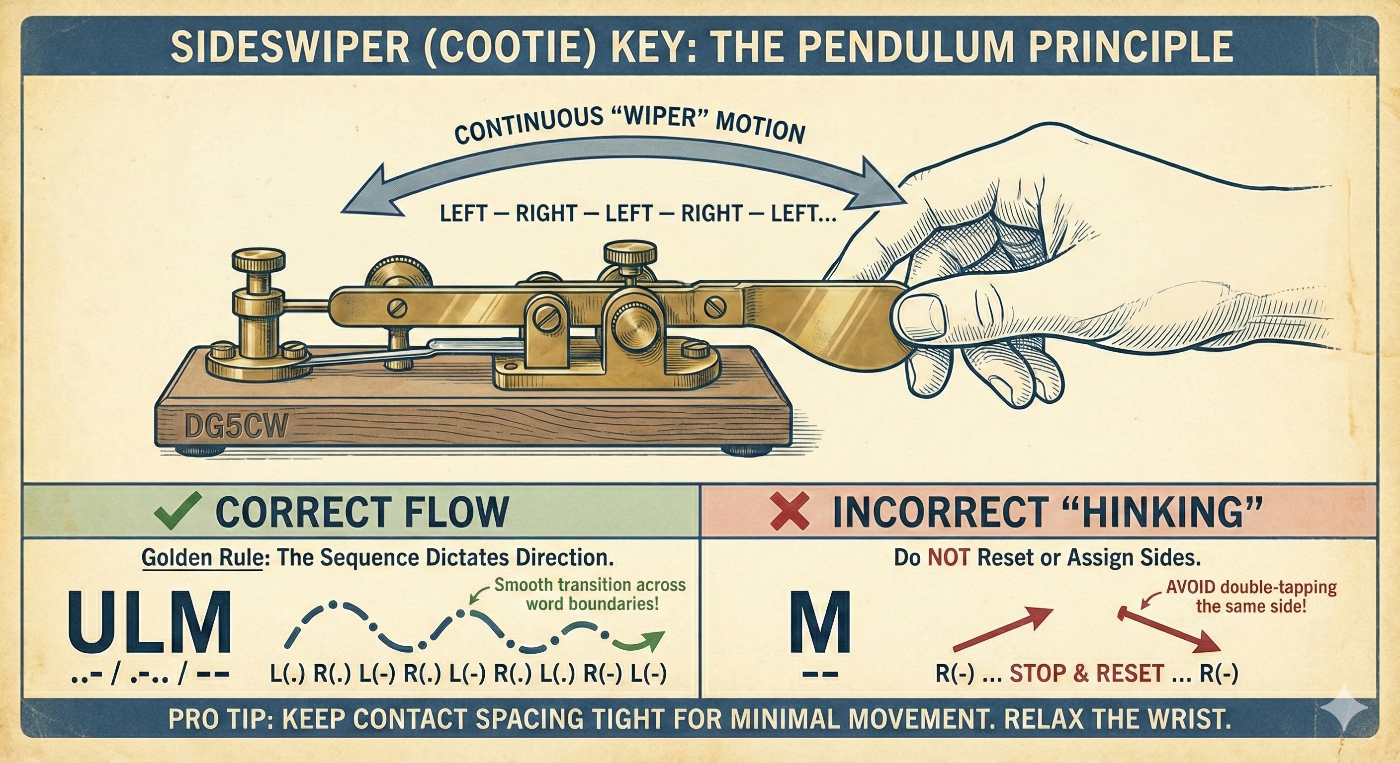
The secret to the Sideswiper is Alternating Motion.
- Left - Right - Left - Right: You strike the key back and forth like a pendulum or a windshield wiper.
- No Resets: You do not assign “dots” to the thumb and “dashes” to the finger. If a letter ends on the left, the next letter must start on the right.
- Flow: You don’t stop. The energy of the return stroke is used for the next element, regardless of whether it is a
ditor adah.
Best Practice Tips
- Find the “Swing” Gap: Unlike electronic paddles which I use with microscopic spacing, I think a Cootie benefits from a slightly wider gap. I need a little bit of travel distance to let the hand accelerate and create momentum. If the gap is too tight, the movement feels stiff/nervous, and I lose the tactile feedback necessary for a fluent rhythm.
- The “Key-Lock” Grip: Avoid pinching the paddle constantly. Leave a tiny gap between your fingers/thumb and the lever.
- Position: My thumb sits same as it typically does on a Bug.
- Motion: The movement is a lateral sweep driven by the wrist. The fingers simply guide the lever into contact.
- Rhythm over Speed: Because you are making every signal manually, timing is everything. 🕰️ Similar to the Straight Kex, it is better to be slow and rhythmic than fast and choppy.
- Trust the Alternation: The hardest part isn’t resetting your hand for a new word; it’s learning to trust the pendulum motion. I know other OPs who prefer consistent starts—always beginning every character on the same side. While that physical reset creates a natural gap and yields cleaner, more readable code for them, continuous alternation works best for me.
💡 Pro-Tip: The “Left Hand” Hack If you are already proficient with a Bug or Paddle, you might find that your thumb tries to “automatically” generate dits out of habit. This is called muscle memory conflict. The Fix: Many Cootie operators recommend learning the Cootie with your non-dominant hand.
- Why? It creates a “firewall” in your brain. Your right hand stays programmed for the Bug (Thumb=Dits), while your left hand learns the Cootie (Left/Right=Alternating).
My Timeline
My goal is to become proficient with the Cootie by the end of 2026. Here is my progress log.
Phase 1: The Setup, The Wiggle & The Switch
January 2026 - February 2026
- Focus: Getting the mechanics right and retraining my brain.
- The Challenge: My right hand (my “Bug hand”) was completely confused. On the Cootie, I caught myself “resetting” the flow to start every word on it’s comparable Bug Dit- or Dah-side, killing the flow. Worse yet, the confusion bled back into my Bug operation: when switching back to the Bug for a QSO, I sometimes found myself trying to send alternating side Dahs instead of just working the dash side contact!
- Milestone: 🧠 The Left-Hand Experiment
- Decision: I decided to learn the Cootie exclusively with my left hand to separate muscle memory and preserve my Bug technique.
- Result: It felt like writing with the wrong hand at first, but the “firewall” in my brain works. No more resetting on the Cootie, and my Bug technique on the right hand remains safe!
- Goal: Error-free sending of a my deticated training page of 5-character groups using my left hand.
- First Cootie contacts: Established my first Cootie contacts from a hotel room in Goa, India with CX5ANA (Aldo), N8LAG (Brian), and BI8CCJ (Dylan) all around 15…18wpm via vBand usig a mini Cootie. 🥳
First time on air with Sideswiper!
- Milestone: 🏆 Very first time on air with Sideswiper!
- Date: 28.02.2026
- THX QSO: F6FTI/P 🙏
- Details: Operating with the left hand at 17…20wpm went pretty well and meant I could log with my right hand - what an unexpected bonus! 😇
Phase 2: Endurance, Comfort & Reliability
March 2026 - xxx
- Focus: Using the Cootie as my primary key for QSOs and Nets (trusting the left hand completely) and extending practice sessions (my left arm muscles need to catch up to the right arm in terms of stamina).
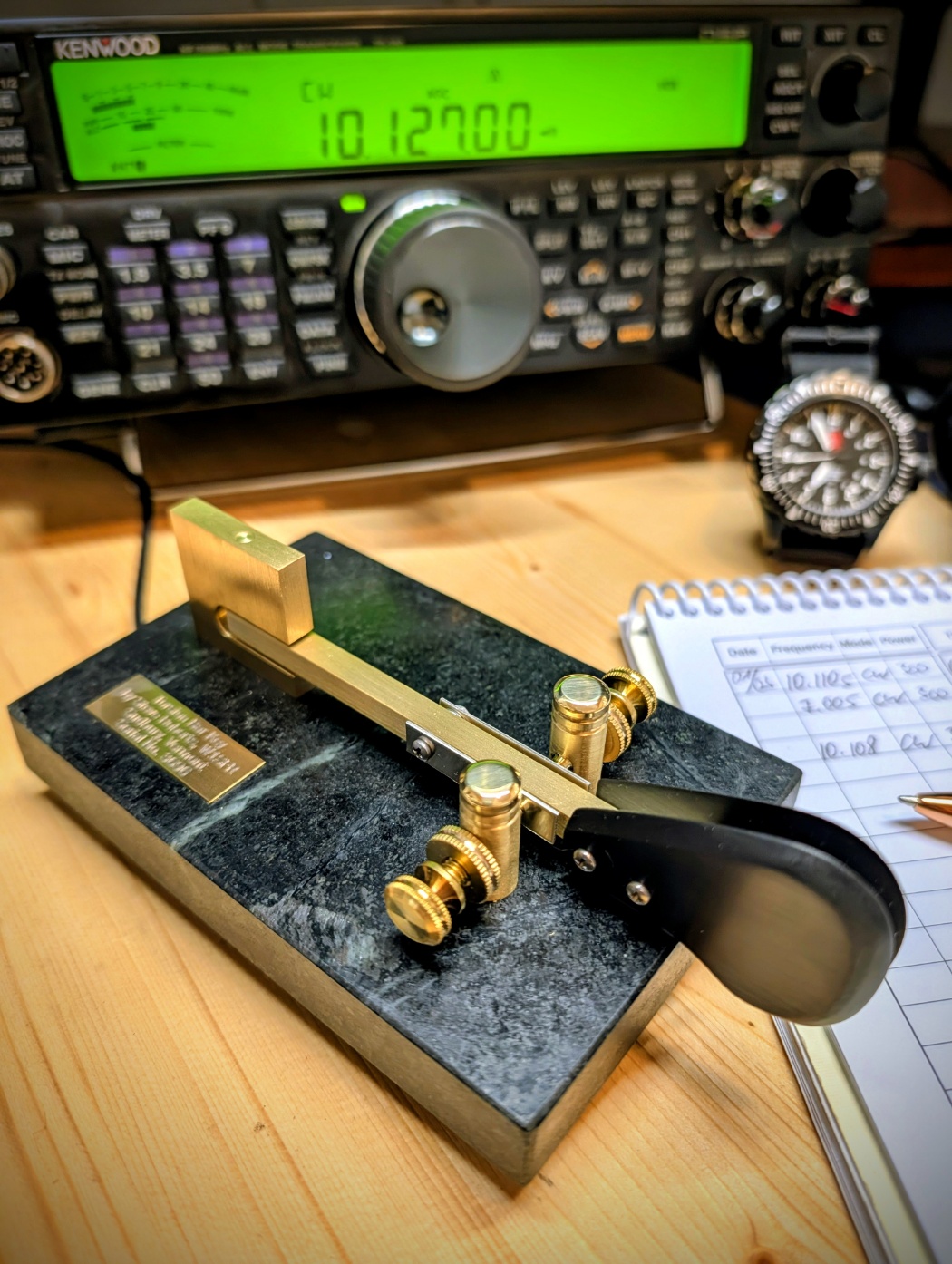
Above: The W1SFR Torsion Bar Key in Action on a Sunday Morning.
Phase 3: Speed & Style
xxx - xxx
- Focus: Increasing WPM slightly while maintaining that characteristic “Cootie Swing.”
- Check-in: Recording my own signal.
Status: Currently in Phase 2 (Mar 2026). See you on the air
Links:
- Official Site: Sideswiper Net
- Themenhomepage: Morsetelegrafieseite DK5KE
- Dedicated training page: Sideswiper Practice Groups